

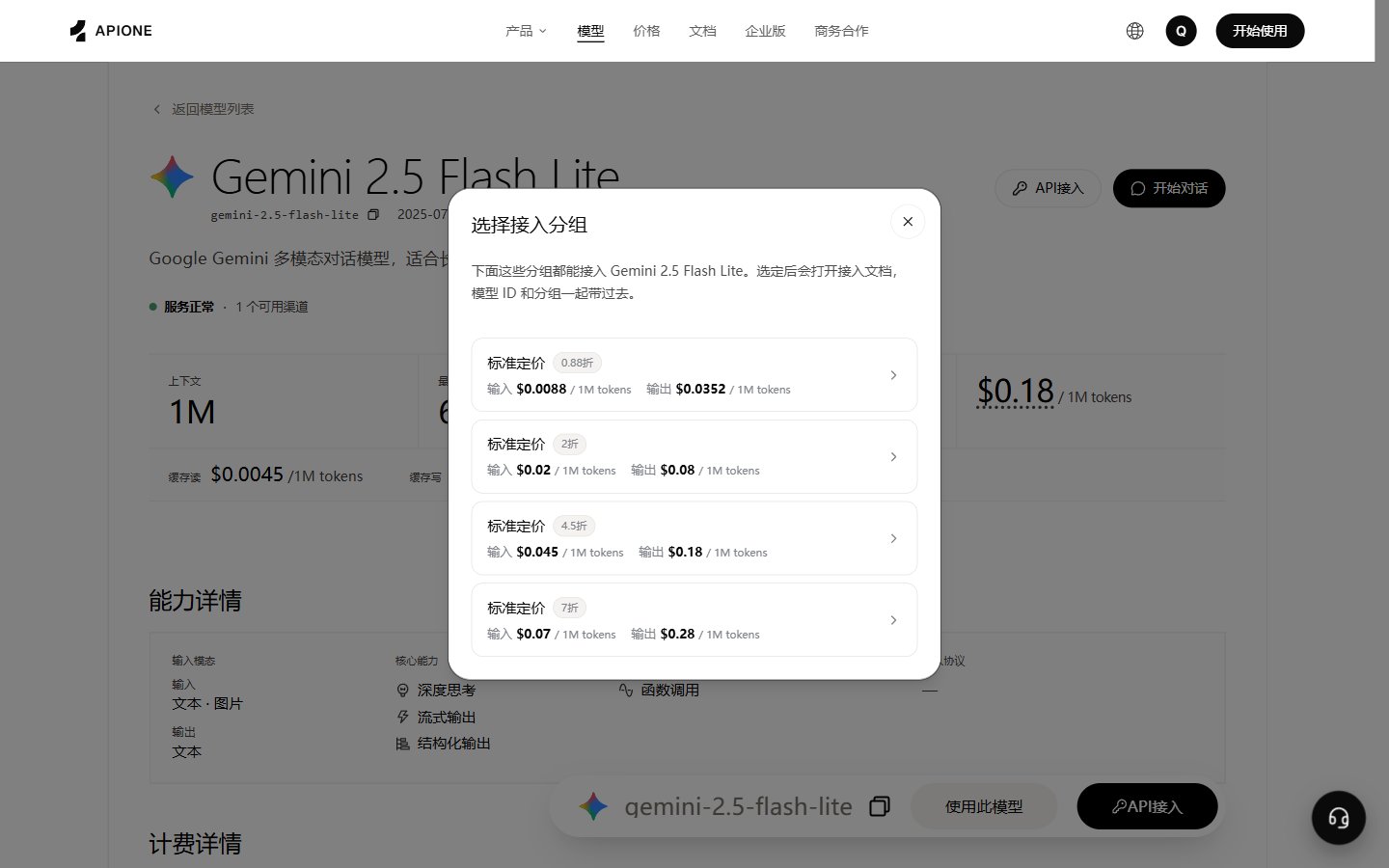
APIONE pricing is often below the provider’s official price, but no fixed discount applies to every model, group, or date. Check the model marketplace and the current key group before use.
APIONE model access group selection

When entering API access from model details, first select the currently available group and verify the corresponding price.

What determines the charge

Different models may bill input tokens, output tokens, cache, requests, images, video duration, parameter tiers, or combinations. A single unified formula cannot cover all models.

Four easily confused concepts

Token billing example

If a model calculates input and output separately per million tokens:
This is a calculation method example, not a fixed quote. Cache, reasoning tokens, media input, and other billing items may be calculated separately.

Media billing

Images may be billed per image, size, quality tier, or request; videos may be billed per second, resolution, task, or combination rules. Before submitting high-resolution, long-duration, or batch tasks, query model parameters and console prices.

Control costs

  • Create separate keys for development, testing, and production.
  • Set project budgets, concurrency limits, and maximum output.
  • Evaluate quality with real business samples, not just choose the lowest unit price.
  • Record request IDs, models, usage, and actual charges for regular reconciliation.
  • Run media tasks at small specifications first, then expand to batch.

Reconciliation checklist

  1. Which key and group was used for the request.
  2. Whether the response model matches the expected model.
  3. Input, output, cache, or media usage.
  4. Whether duplicate requests or automatic retries occurred.
  5. Whether console request details match account transaction records.
Web chat, images, video, and API calls share the APIONE balance. The pay-as-you-go balance is separate from plan credits. Plus, Pro, and Max are one-time purchases with all credits issued at purchase and 28-day validity; they do not renew automatically. Upgrades keep the original expiry time. See usage and plan rules.

Base price and effective group price

When a price is explicitly labeled as a “base price,” apply the current group rule once to convert it. When explicitly labeled as “current group price” or “effective price,” it already includes that group’s discount: multiply it by usage directly, without applying the discount again. Supplier reference prices are for comparison only. When the price basis is unclear, first verify the selected key and group, then calculate the charge.

Reconciliation example

The following are illustrative values and do not represent an actual model quote: current group effective input price is $1 per million tokens, effective output price is $4 per million tokens; a single request has 10,000 input tokens and 2,000 output tokens, with no cache or other billing items.
For actual reconciliation, use the same request’s request identifier to associate the response with console details. Verify item by item: model, group, billing time, input/output/cache usage, effective unit prices, and final charge. Display rounding, extra billing items, and independent retries should be checked separately; do not judge overcharging based solely on total token count. Next: Usage, costs, and limits, Model parameters, FAQ.